Electricity
isn’t the first thing you picture when you think of Valtellina’s mountains. But
look closer and you’ll see how water, stone, and steel have shaped both the
landscape and daily life. With 25 minor dams and 27 major ones, this northern
Italian valley generates around 12% of Italy’s hydroelectric power — and half
of Lombardy’s. Many of these colossal works, dating back to the early 20th
century, now double as unlikely destinations for hikers, cyclists, and curious
travellers. Walk the high dam walls, known as coronamenti, and the valley
plunges away beneath you; circle the reservoirs by bike and you’ll discover
views where engineering and nature blur.
DAMS IN VALTELLINA... where music meets engineering
Up the
valley in Valdidentro, just beyond the Torri di Fraele, lie the twin Cancano
lakes. Construction began in the 1940s with the San Giacomo dam, 91 metres high
and nearly a kilometre across. Cancano II followed in the 1950s, its wall
soaring to 136 metres. Together, they form a stunning 20km loop — best tackled
on foot or, better yet, by gravel or mountain bike. Peaks and glaciers reflect
in turquoise water as you climb; park close by to the towers, or add Cancano’s
legendary hairpin climb to your cycling route for the full reward.
In
Valmalenco, the Alpe Gera and Campomoro dams stand as mid-century engineering
icons with an unexpected cultural twist. Italian singer-songwriter RAF filmed a
music video at Alpe Gera in 2007, while Campomoro hosted World Cup high-diving
events in 2009 and 2011. Built between 1958 and 1965, the basins collect the
waters of the Fellaria and Scerscen glaciers. At 2,051 metres, Alpe Gera is
Italy’s highest operating dam. Crossing its wall is unforgettable — raw
concrete, alpine silence, and sheer drop-offs. Circular hikes link to Alpe
Gembrè (2,224m) or Rifugio Bignami. Plus, sport fishing is also permitted June
through October with a regional licence.
Farther
west, Valchiavenna’s Montespluga lake was formed in 1931 by damming the Liro
river. Its dramatic setting has inspired filmmakers, appearing in a cult 1985
movie and, more recently, in a Mahmood music video. Today, visitors come for
the varied hiking routes, especially the 6.6km route to Lago Nero, or the 12km
Rifugio Bertacchi circular. The scenery shifts from the rugged rock faces of
the Cardinello gorge to more mellow landscapes around the lake and village.
POWER STATIONS AS ARCHITECTURE
The story
doesn’t end with the dams. Valtellina’s hydroelectric network began in 1900 at
Campovico, just outside Morbegno, built to power the valley’s railways. It was
the first of what would become 86 hydro plants — a network of various size
plants that still hums beneath the mountains. Some, like the Mese station of
1927, were once among the most powerful in Europe. What’s most eye-catching,
though, is the architecture. Belle Époque flourishes, Jugendstil windows and
Art Deco façades appear where you least expect them, set against alpine
pastures. Fraele power station (construction began 1922; operational from 1928)
is a highlight: decommissioned in 2004, it is industrial archaeology at its
most photogenic and open for guided visits in summer as part of the Water
Routes Po Valley ERIH project.
Several
stations remain in operation and welcome visitors by appointment. Lanzada’s
Alfredo Pizzoli plant offers guided tours and interactive visits (book via 0342
451150 or info@sondrioevalmalenco.it). In Grosio, A2A hosts tours of its 1917
Pietro Portaluppi–designed station (including its 600-metre tunnel carved into
the mountain). And in Valchiavenna, the Prata (Mera II) plant also opens its
doors, offering another perspective on the intersection of energy, design, and
landscape.
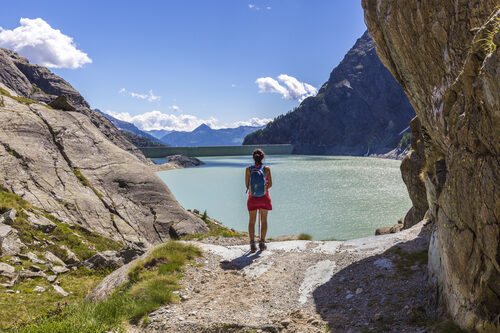
- La diga di Alpe Gera, in Valmalenco
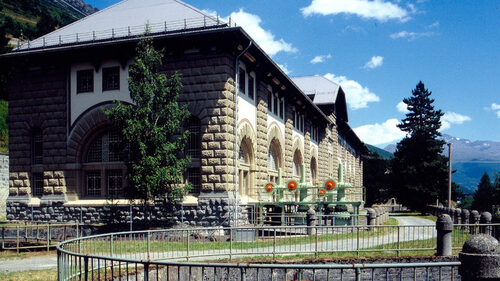
- Centrale idroelettrica di Fraele, in Valdidentro


